
PDF Ebook The Undercover Economist, by Tim Harford
As well as why we recommend it to check out because spare time? We understand why we advise it due to the fact that it remains in soft data forms. So, you can save it in your gizmo, as well. And also you always bring the device any place you are, don't you? To ensure that means, you are available to read this publication all over you can. Currently, allow tae the The Undercover Economist, By Tim Harford as you're reading product as well as obtain easiest way to read.
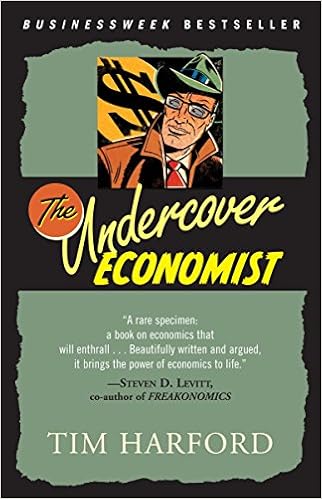
The Undercover Economist, by Tim Harford

PDF Ebook The Undercover Economist, by Tim Harford
Reviewing is a pastime to open up the expertise home windows. Besides, it can supply the inspiration and also spirit to face this life. By in this manner, concomitant with the modern technology development, several business offer the electronic book or publication in soft data. The system of this publication obviously will be a lot easier. No worry to neglect bringing the book. You can open the tool and also get the book by on-line.
But, exactly what's your matter not as well enjoyed reading The Undercover Economist, By Tim Harford It is an excellent activity that will always provide terrific benefits. Why you end up being so bizarre of it? Lots of points can be sensible why individuals do not want to review The Undercover Economist, By Tim Harford It can be the monotonous tasks, guide The Undercover Economist, By Tim Harford compilations to check out, also careless to bring nooks everywhere. But now, for this The Undercover Economist, By Tim Harford, you will begin to like reading. Why? Do you know why? Read this page by completed.
Asking why? You have actually seen that this site has plenty of wonderful books from variant publishes a libraries worldwide. Getting a restricted edition publication is likewise easy right here. You can discover The Undercover Economist, By Tim Harford, as example to be your turn and also your selection currently. Since, we will certainly not hide anything about it right here. We offer you all the very best from The Undercover Economist, By Tim Harford that the author produced particularly for you.
You can alter your mind to be much better after getting the resources from some documents. But when you have the resources from this publication, you could take how different this book view from others. Yeah, this is what makes you feel finished to conquer the feature of the resources. The Undercover Economist, By Tim Harford turns into one referral that supplies the presence of new info as well as ideas. Now, your time is for getting guide faster. This is it the book that you need now!
Review
"Required reading."—Steven Levitt, author of Freakonomics"A playful guide to the economics of everyday life, and as such. . . something of an elder sibling to Steven Levitt’s wild child, the hugely successful Freakonomics."—The Economist"A book to savor."—The New York Times"The Undercover Economist is a book you must pick up if you want a fresh perspective on how basic ideas in economics can help in answering the most complex and perplexing questions about the world around us."—Business Today“[Harford] is in every sense consumer-friendly. His chapters come in bite-size sections, with wacky sub-headings. His style is breezy and no-nonsense. . . . The Undercover Economist is part primer, part consciousness raiser, part self-help manual.” --Times Literary Supplement"Anyone mystified by how the world works will benefit from this book – especially anyone confused about why good intentions don’t, necessarily, translate into good results."—The Daily Telegraph (UK)"Harford writes like a dream – and is also one of the leading economic thinkers of his generation. From his book I found out why there’s a Starbucks on every corner, what Bob Geldof needs to learn to make development aid work properly, and how not to get duped in an auction. Reading The Undercover Economist is like spending an ordinary day wearing X-ray goggles."—David Bodanis, author of E=mc2 and Electric Universe"Popular economics is not an oxymoron, and here is the proof. This book, by the Financial Times columnist Tim Harford, is as lively and witty an introduction to the supposedly 'dismal science' as you are likely to read."—The Times
Read more
About the Author
Tim Harford is an editorial writer at the Financial Times, where he also writes the newspaper’s “Dear Economist” column and “The Undercover Economist” column, which also appears in Slate. He lives in London.
Read more
See all Editorial Reviews
Product details
Paperback: 265 pages
Publisher: Random House Trade Paperbacks; Reprint edition (January 30, 2007)
Language: English
ISBN-10: 0345494016
ISBN-13: 978-0345494016
Product Dimensions:
5.2 x 0.6 x 8 inches
Shipping Weight: 7.5 ounces (View shipping rates and policies)
Average Customer Review:
4.1 out of 5 stars
243 customer reviews
Amazon Best Sellers Rank:
#109,461 in Books (See Top 100 in Books)
A lot of people are going to draw comparisons between The Underground Economist and the inexplicably popular Freakonomics particularly since the author of Freakonomics is used as the leading quote on the cover. The fact of the matter is that Freakonomics had very little to do with traditional economics per se while Underground is pretty much an economics books with some coolness added to keep it entertaining. The first chapter is essentially a primer on supply and demand.Tim Harford is an economist from England who pushes a free-trade, pro-globalization agenda. In fact two of the five authors with quotes on the back cover have pro-globalization books in their `Author of' section. The second to the last chapter is a hard sell of globalization and the final chapter is a portrait of the happy results of globalization in China. Harford also comes down on taxes saying they are inefficient and destroy competitiveness. Instead of a progressive income tax he argues in support of a flat sales tax. It all sounds like a sale of conservative economics which isn't necessarily a bad thing as long as it's done with honesty and clear thinking (many conservative economists have such an ideological bias that they become useless).The author spends a chapter on healthcare in the United States and demonstrates how flawed it is. The system is hugely expensive, highly bureaucratic, extremely patchy and unpopular to most American's. Harford writes, "United States government alone spends more than the combination of public and private expenditure in Britain, despite the fact that the British government provides free health care to all residents" In fact no country spends more as a percentage of the GDP as American's. Not even close. And as a final kick in the teeth American's aren't even particularly healthy when compared to the rest of the developed nations. However, rather than look to his own country's model for health care or Germany's or Canada's Mr. Harford looks to Singapore. It seems as if the author has mind melded with the Bush administration in believing that American's are over insured and need to look into Health Savings Accounts which to the best of my knowledge don't address ANY of the problems the author recounted. The book contains some real insight on why health insurance is often incompatible with a market based economy but the idea that we should just scrap it in favor of only catastrophic health insurance seems to deny that anyone could possibly be nickeled and dimed into poverty.The author also has some interesting views on handling pollution. The idea is that companies can buy the right to pollute using vouchers. Initially it seems to be a horrible idea but the thinking is that since businesses regularly inflate the cost of keeping clean we ask them to put their money where there mouth is. If the vouchers cost enough businesses will try to find cheap ways to stay under the emissions threshold rather than pay the voucher cost and the problem is solved in a very market based manner. On the other hand the author tends to discount environmentalism as a small cost (2 percent of manufacturing) and of little real concern to businesses. If this is true than why do business interests in the United States spend millions on think tanks and lobbying if it's no big deal? Global Warming is a huge deal and business seems willing to do just about anything to suppress legislation.Besides globalization the author doesn't seem to really be an ideologue. He is clearly a fan of market based economies but admits that participants often don't act sensibly. He's no cheerleader for the stock market by pointing out that price to earning ratios of companies are still vastly inflated and gives a great explanation on why internet companies lack any scarcity power making their ridiculous stock values in the late 90's look like nothing more than a fools dream. The Underground Economist is a very good book. Unlike Freakonomics it is legitimately an economics book and most assuredly has an agenda. Not that that's a bad thing.
I remember one lesson from this book, which I read 10 years ago, that a coffee shop will often pay $1.00, $1.10 and $1.20 for three sizes or qualities of coffee, but will charge the consumer $2.00, $3.00, and $4.00 respectively. The customer then dictates the level of luxury (and profit) they desire, without the business having to do so. Even though I could figure as much, they put it in a way that changed my life and business approach, and they provided an example I often share. I would give this book five stars if I remembered another example!
Summary and review of The Undercover Economist by Tim Harford (Kindle edition)I bought this book as a layman trying to understand how economists think. The first few chapters were interesting, as the author attempts to explain basic notions such as “the world of truthâ€, marginal value, free trade, game theory, and more. The explanations were clear and the writing quite engaging. Things fall off in the final chapters, revealing some of the bigger problems with economic thought, or at least with this economist’s thinking. Specifically, chapter 8 attempts to discuss why poor countries are poor. Clearly the author is trying to show us that the reason is the lack of free markets and correct incentives. But that begs the question: Why are some countries able to get this right and others not? The author fails to provide an answer because he ignores an important factor: culture. Chapter 9 is even worse, as the author discusses the grand benefits of globalization. Sure, there are benefits, but he ignores the disadvantages and also the fact that these benefits are not spread evenly throughout society, at all - some sectors are getting killed. The author writes like someone who is so busy drinking Belgium draught beer in a pub in London and flitting about the world in pursuit of new sights and sounds, that he cannot hear nor see the suffering that is being caused to others ("sweatshops are great compared to the alternative", as he puts it). Perhaps such attitudes are why economists are considered to be soulless… The final chapter sets up China as a shining example of the successes of globalization. The really funny thing here is that the author completely ignores the fact that China’s success is built on a consistent policy of protectionism through subsidies, tariffs, and currency manipulation – the exact same things that the author spends the entire book condemning! So apparently, protectionism is great when it helps China but awful for everyone else?? I don’t know how else I’m supposed to understand this chapter.Bottom line: This is an inconsistent book by an economist who seems to be madly in love with himself. I’m sure there are better books to serve as an introduction to economics.
My 17 year old grandson told me of this book. He liked it and I read it to talk with him about it. I found it very delightful from the first page and have been discussing the issues the author raises with my mid 50 year old children. Can't recommend it enough. The author provokes thinking about our economic life and how it creates our world. It is easily read and understood.
Very interesting book, expecially the final chapters:--how China ascended from utter economic oblivion to being the 2nd largest world economy--why the poorest nations in the world are poor and may never changeIf you like this, be sure to listen to or read Tim Harford's "50 things..." https://www.amazon.com/gp/product/0735216134 . It is available as BBC podcasts or book. IMHO, it should be required reading/listening for everyone.
This particular book changed my perspective on how to think. The analysis of normal things and phenomenon is so logical and intelligent. I absolutely love the way of logical deduction from Tim Harford. This book is also surprisingly easy to read. It doesn't have equations or graphs that a regular economy textbooks would have. You need to read this book if you haven't read it yet!
The Undercover Economist, by Tim Harford PDF
The Undercover Economist, by Tim Harford EPub
The Undercover Economist, by Tim Harford Doc
The Undercover Economist, by Tim Harford iBooks
The Undercover Economist, by Tim Harford rtf
The Undercover Economist, by Tim Harford Mobipocket
The Undercover Economist, by Tim Harford Kindle
0 comments:
Post a Comment